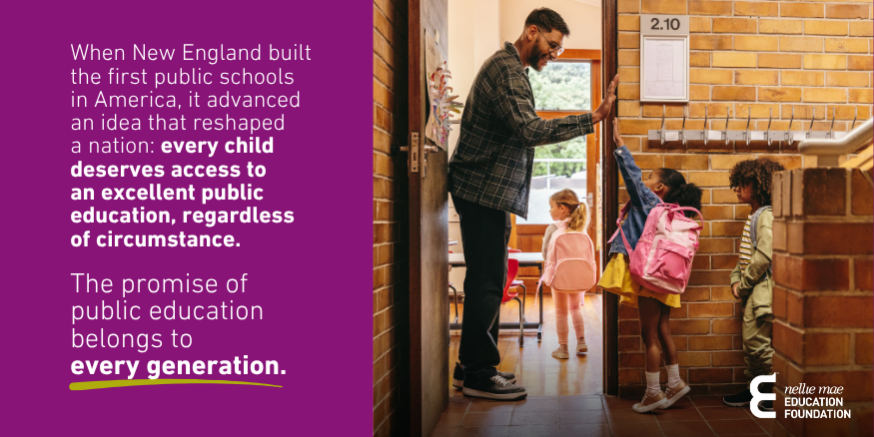
When New England built the first public schools in America, it advanced an idea that reshaped a nation: every child deserves access to an excellent public education, regardless of circumstance. Every generation has worked to expand the definition, access, and application of who that promise belongs to. In 2001, twenty-five years ago, the Nellie Mae Education Foundation took its name and set out to do just that, right here in New England.
As we mark our twenty-fifth anniversary, we are Reflecting Forward on what the field has taught us and what we’ve helped build alongside communities and partners. This is not a look back at our history. Instead, it’s an opportunity to examine how our understanding has evolved and how we can put that learning to work in the years ahead.
Real progress requires more than a single promising program or isolated reforms. It requires communities with the resources and influence to shape solutions, infrastructure that connects knowledge to action, and organizations locking arms to work towards a shared vision for our young people.
The promise of public education belongs to every generation. Fulfilling it is a shared responsibility, and one we will continue to take up with communities across New England.
Roots That Run Deep
Over 25 years, we’ve been reminded that lasting change depends on whether the systems surrounding students can deliver on the promise of public education. We’ve seen promising approaches emerge, and communities develop innovative ways to meet students’ needs. But we’ve also seen how progress can stall when promising efforts lack the broader support or connections to take hold.
Every evolution in our strategy reflects a growing understanding of what it takes to move towards durable, systems-level progress.
1990-2000
Our story begins before the Foundation itself. In 1990, the Nellie Mae Corporation, a nonprofit education-financing company, created the Fund for Education, pioneering philanthropy within the student loan industry. Over the next eight years, the Fund provided $5 million in grants and support to more than 300 education partners across the region.
In 1998, the Nellie Mae Foundation was formed. The following year, Sallie Mae purchased the Nellie Mae Corporation, and the proceeds of that sale created the endowment that still funds our work today. Its earliest work focused on improving underserved students’ access to higher education.
Becoming an Education Foundation
2001-2007
In 2001, Nellie Mae Foundation become the Nellie Mae Education Foundation. In the years following No Child Left Behind, schools and communities faced growing pressure to demonstrate progress through standardized measures, while much of the field’s attention remained focused on individual programs: reading initiatives, out-of-school programs, and adult learning pathways. We supported four ourselves: Adult Learning, College Prep, Minority High Achievement, and “Out-of-School Matters!” The Foundation awarded more than $80 million in grants to help students prepare for and access college.
These were essential programs that we were proud to support. But this period also taught us that even effective programs have narrow reach when the systems around them stay the same.
From Programs to Systems
2008-2009
In 2008, we shifted our focus from college access to education systems change, with a broad new agenda that brough policy, public engagement, research, and communications together alongside grantmaking.
Championing Student-Centered Learning
2010-2014
As Race to the Top pushed states toward new standards and Common Core reshaped classrooms nationwide, we stayed close to what was happening in New England schools. This was a moment to help states adapt reforms to local realities that centered students, not implement top-down reforms. We focused grantmaking on four key initiatives: District-Level Systems Change, State-Level Systems Change, Research and Development, and Public Understanding and Demand. As we broadened the communities we served, this experience reinforced the importance of connecting state-level decisions with the experiences of the people those decisions affect.
An Audacious Goal, and a Look in the Mirror
2015-2019
When The Every Student Succeeds Act gave states greater flexibility to design their own accountability systems, we saw an opening for New England to help lead the next era of public education. States that had been operating under prescriptive federal mandates had greater room to define achievement on their own terms. In response, we set an ambitious goal: that 80 percent of New England students would be college and career ready by 2030.
But it was also time to turn the same scrutiny on ourselves that we’d been applying to the field. We needed to examine our own work, culture, and practices and came to see that serving all of New England’s young people required us to confront the structural, racial inequities and opportunity gaps in public education.
Centering Community and a Defining Test
2019-2024
That internal work led to an updated vision, mission, and values, and to the creation of a Community Advisory Group of teachers, students, parents, and organizers who continue to shape our grantmaking today. This marked a shift in how we understood our role in ensuring that community perspectives help define the problems and solutions. Advancing student-centered education requires supporting their ability to influence the decisions that shape young people’s lives. In January 2020, we announced a new grantmaking strategy focused on advancing racial equity in public education.
But all of the intentional learning could not have prepared us for what was to come: a global pandemic that emptied classrooms overnight, exposed how deeply those inequities shaped students’ experience and how difficult it was for institutions to respond. The crisis reminded us that lasting change for our students depends on the strength of the infrastructure connecting and supporting them. Communities and organizations need durable coalitions, accessible data, and strong regional relationships to not only respond to crises, but to sustain progress over time. That recognition helped clarify where Nellie Mae could contribute most.
What We’re Building Now
Our world is changing rapidly. Emerging technologies, an evolving workforce, and a shifting federal role are reshaping what young people need and what public education must deliver.
Beginning in 2024, we undertook a strategic evolution informed by more than 2,500 young people, parents, educators, community members, organizations, and public administrators across New England, alongside national partners, and colleagues. Together, those voices clarified a shared vision:
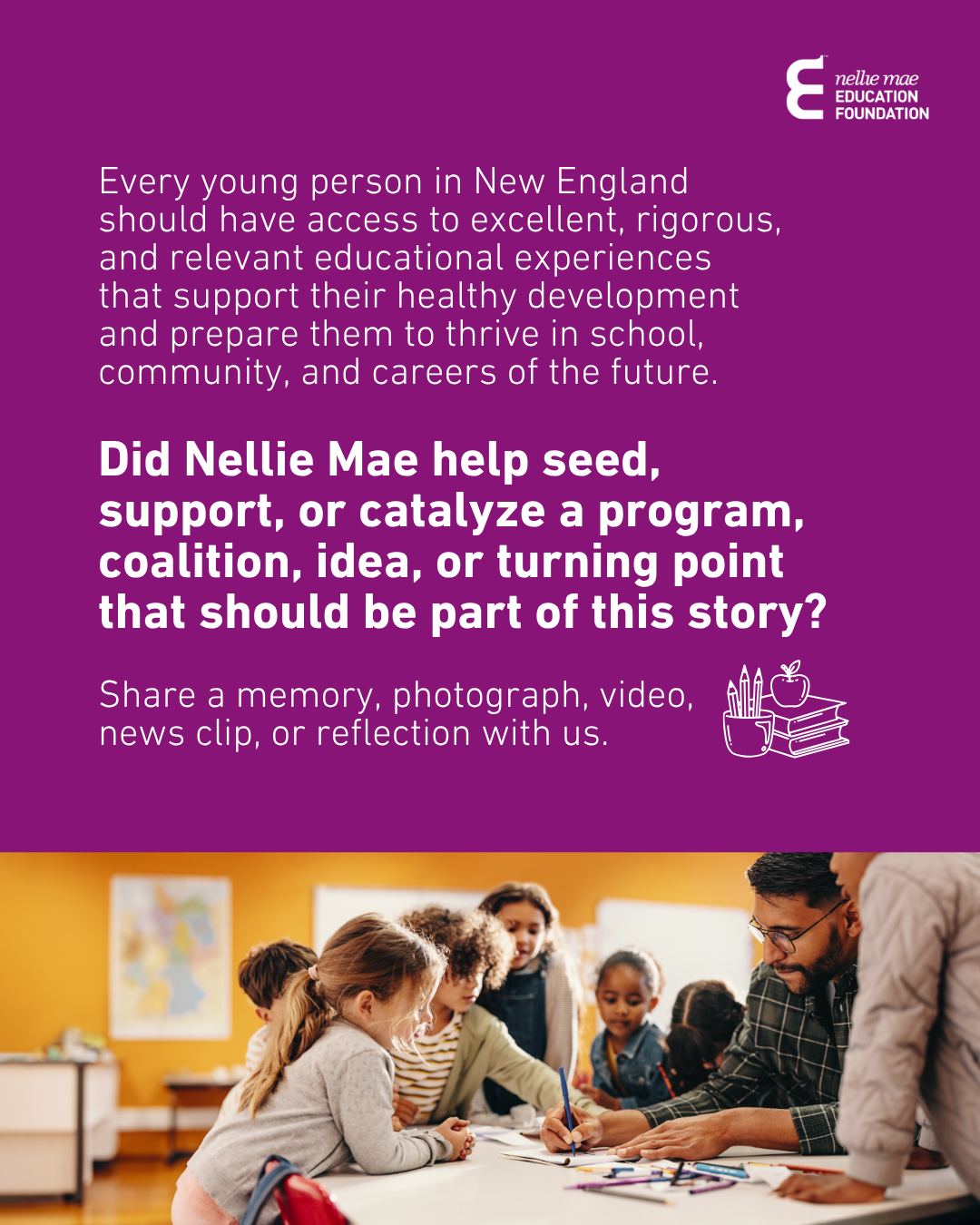
Every young person in New England should have access to excellent, rigorous, and relevant educational experiences that support their healthy development and prepare them to thrive in school, community, and careers of the future.
In support of that vision, we’re working towards a New England education landscape that is:
- Grounded in student and family voice
- Driven by strong community and institutional partnerships
- Informed by a durable data and knowledge infrastructure
- Enabled by aligned, policy, practice, and funding
- Sustained by a connected field
With that vision as our guide, we asked a critical question: what will it take to make that possible, and where can Nellie Mae make the greatest contribution? Input from communities and our own reflections helped us understand that our role is to serve as a catalyst for partners across the region and nation to work together to:
- Build and reinforce data and knowledge systems so communities can see and respond to need
- Convene and align actors around a shared agenda for public education
- Expand who holds influence and voice in shaping solutions
To that end, we are focusing our investments in three interconnected areas:
- Community Engagement: Working so that those most proximate to the challenges we face have the support, resources, and infrastructure to shape and advance a shared agenda, as well as supporting communities to use qualitative and quantitative data to define root causes of student disengagement and develop actionable solutions.
- State Fieldbuilding and a Knowledge and Information Ecosystem Infrastructure: Supporting a durable, responsive information infrastructure for excellent public education, so state and local leaders can apply what’s known and act on it.
- Regional Field and Capacity Building. Advancing a unified vision and shared agenda, informed by community insights and data, that activates others and builds momentum for long-term systems change.
Over 25 years, we’ve learned that lasting change depends on more than any single organization or initiative. We cannot do this alone and we are not meant to. Only if we work together can our shared vision become a reality for all young people across New England.
What Comes Next
This is the opening chapter of Reflecting Forward, our year-long twenty-fifth anniversary campaign. In the months ahead, Reflecting Forward will revisit the people, partnerships, and ideas that have shaped public education across New England; examine what they have taught us about how change happens; and explore what it will take to build on that progress in the years to come.
We also know that no institutional archive can capture the full story of this work. It lives in the experiences of students, families, educators, organizers, and community leaders, as well as in the coalitions, ideas, and efforts that have helped move the field forward.
Did Nellie Mae help seed, support, or catalyze a program, coalition, idea, or turning point that should be part of this story? We invite our partners and community members to share their memories, photographs, videos, news clips, and reflections with us. These contributions will help us tell a fuller story of what has been built and the people whose work made it possible.
The challenges facing public education will continue to evolve. Our commitment is to apply what 25 years have taught us. Together, we can ensure every young person has access to excellent, rigorous, and relevant educational experiences that support their healthy development and prepare them to thrive in school, community, and careers of the future.