My Next Chapter
Reflections from our Incoming Director of Community & Partnerships
In a recent conversation with our President and CEO, Dr. Gisele C. Shorter, we reflected on the question, “What is the best use of this one good life?”
In July, I’ll be stepping into a role that brings my values, experience, and aspirations into even closer alignment. I’m proud to announce that I will serve as Director of Community & Partnerships at the Nellie Mae Education Foundation (NMEF). I want to share what that means to me and why.
I am the son, grandson, and great-grandson of Mexican migrant farmworkers. I was the first in my family to go to college. My work has always been personal, shaped by growing up watching communities like mine navigate systems that were not designed with us in mind. I chose to participate in reshaping them because just as systems are built, they can be rebuilt for the better.
My career began as a community organizer at the U.S. Hispanic Leadership Institute, focusing on civic engagement, voter registration, leadership development, and research and data analysis to inform advocacy and narrative change. I traveled the country helping communities understand how policy was developed, how budgets were formulated, and how to get involved in local government. I worked to expand access to decision-making spaces that have historically excluded Latinos and communities of color.
That work led me to the Chicago Board of Election Commissioners, where I helped operationalize the Help America Vote Act of 2002, which required voting districts across the country to modernize their equipment and make voting more accessible. I worked with a team to develop a curriculum and training program for Polling Place Administrators. We trained thousands of election workers and supported the transition of more than 2,000 Chicago polling places to new systems, procedures, and policies. It was painstaking, practical, and essential work to make the machinery of democracy more accessible to everyone who depends on it.
I later returned to the U.S. Hispanic Leadership Institute and became the Director of Operations. That’s when my curiosity about philanthropy began to form. Anyone who’s done organizing knows the pressure that comes from the limited funds available for the kind of work we do. We would see surges of funding during presidential election years for nonpartisan voter registration and engagement, but limited dollars in off years, even though the problems we were trying to solve can’t be fixed in one election cycle.
I wanted to understand how philanthropic funding worked, how strategy was developed, priorities were set, and how decisions were made. I knew that I had a perspective to offer and the skills to partner with communities to help transform philanthropic organizations from ivory towers to community-centered institutions.
It was ultimately the advice I was giving to the communities I served, to find their seat at decision-making tables, that made me take the leap. I participated in the Proteus Fund Fellowship Program, which offered mid-career professionals of color the opportunity to learn and experience the role of a program officer. I was selected by EdVestors, a Boston-based organization focused on school improvement, collaboration, and knowledge creation, to support their grantmaking. I learned how to become a grantmaker who designs for systems-level opportunity, facilitates fair selection processes, advises grantees along the way, and helps them track their progress.
After my fellowship ended, I was invited by the Barr Foundation to temporarily support grantmaking for a year, which turned into two. It was an incredible opportunity to learn more about grantmaking, as Barr is among the largest private foundations in New England with almost $2.5 billion in assets. I managed $6 million in annual grantmaking focused on out-of-school time and K-12 strategies designed to re-engage young people who were struggling at school and expand opportunities for young men of color in Boston.
Once that position ended, I landed a role as a program officer at NMEF. My career has grown from Program Officer to Director of Grantmaking, and now I have the honor to step into the role of Director of Community & Partnerships.
Over my eleven years at NMEF, I have led the design, implementation, and adaptation of multi-million-dollar grant strategies focused on systems change for students least well served, across more than 25 school districts and 50+ community-based organizations throughout New England.
One of the most important things I learned along the way came not from what we got right, but from a hard truth we had to face: philanthropy does not always authentically engage communities in strategy development and implementation. We had sometimes defined the problem and selected the interventions before truly engaging young people and families. We have since pivoted our approach to center authentic community voice early and examine underlying root causes of inequities before defining the problem and designing solutions. That pivot and the learning it produced directly shaped NMEF’s strategy today.
At the end of 2025, we finalized our refined strategy, one that I knew I wanted to help bring to life. The strategy asks NMEF to do something genuinely hard: build the foundation of civic infrastructure that enables communities to identify their own priorities, lead their own solutions, and hold systems accountable for delivering on them. Three strategic pillars center our commitment to placing those closest to the challenges in the driver’s seat: Community Engagement, State Field Building, and Regional Capacity Building.
We are in the process of engaging 30+ communities across New England over a 20-year strategy arc to deliver education systems designed to support the well-being and future success of all students. We are building tighter connections between community-level work, state fieldbuilding, and regional capacity, the kind of coherence that I believe has real potential for impact. We are building a bigger tent, bringing in more partners, more funders, more aligned actors. That organizing logic applied at a philanthropic scale is norm-defying, and the work I have been preparing for my entire career. This role gives me the opportunity to do more of the work I am most passionate about, at a moment when it matters most.
One of the most exciting things about working at NMEF is the people. I am part of an extremely talented team. We are committed to advancing our mission and working in fundamentally different ways. Instead of refining the old playbook, we’re writing a new one.
I don’t take lightly the political and civic context in which we’re working to make public schools welcoming to all our children. As I look back on my past work and consider the future of this role, I’m thinking about my two daughters. Like many parents, I want to leave behind a world they are proud to inherit.
I see nothing more important to the future of this region and the country than fighting for young people’s freedom to learn by ensuring that schools have the resources to serve every child who walks through their doors. The strength of our democracy is determined by the strength of our schools because who gets access to a rigorous, affirming, well-resourced education determines who gets to participate fully in civic life—and who doesn’t.
What I see in the midst of that fear and uncertainty is a field ready to transform the future of education for the next decade, if not century, if we’re willing to do it together.
That is why this new role, this foundation, and this moment feel like a turning point not just in my career, but for everything we’ve built over the past 25 years of NMEF’s presence in New England.
The question Gisele and I pondered wasn’t really about the job. It was about purpose; whether the work you’re doing reflects who you are and what you believe, not just what you’re capable of… and I can’t think of a better use of my one good life than what I’m doing now.
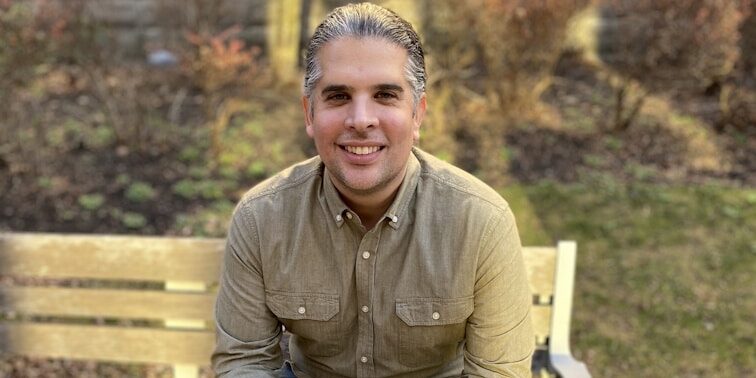
Marcos Lucio Popovich is the incoming Director of Community & Partnerships at the Nellie Mae Education Foundation. He has been with the Foundation since 2015.